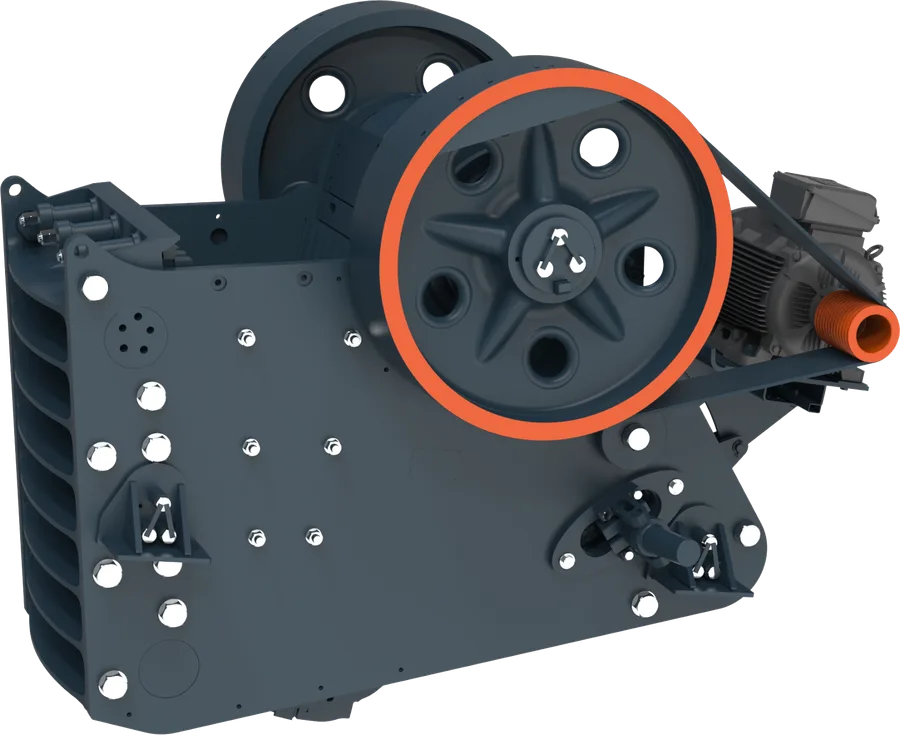
Primary crushing sets the tone for every ton that follows. The real choice factors are maximum feed size, sustained t/h, civil footprint, and keeping closed-side setting (CSS) stable as liners wear. This guide is for mining and aggregates RFQs—not a substitute for a site flowsheet study.
NORDVIK™ crushing equipment is a trademark of Luoyang Pascal; promotion and sales are entrusted to Luoyang Songju Industrial Equipment Co., Ltd. (Songju Equipment). We are not affiliated with shipping or logistics brands that also use the name “Nordvik.”
For machine families, start with the JC jaw crusher and GC gyratory crusher pages. For a broader jaw / cone / impact overview, see the existing circuit machine guide.
What “primary” actually requires
A primary stage must accept run-of-mine or blasted rock, reduce it to a size the secondary plant can digest, and do so without constant choke or tramp events that stop the line. Before you pick jaw or gyratory, lock these inputs:
- Maximum feed dimension (mm) and the share of oversize that must pass without pre-screening.
- Target primary product — typical top size to secondary, or OSS/CSS band if already specified.
- Required continuous capacity (t/h) at the design bulk density—not a peak hour figure.
- Rock abrasiveness and clay / moisture — drives liner alloy and chamber cleaning behavior.
- Civil and logistics limits — headroom, crane capacity, foundation size, and whether the plant is modular or permanent.
If those five fields are blank, vendor quotes will diverge for the wrong reasons.
When a jaw crusher wins
Jaw crushers remain the default primary for many quarries and mid-scale mines because the machine is compact relative to capacity, easy to stage as a standalone primary, and forgiving when feed varies day to day.
Choose jaw when most of the following are true:
- Feed openings in the mid-primary band fit your blasted top size (NORDVIK JC Series: nine models, openings from 800 × 510 mm to 2,000 × 1,500 mm, installed power 75–400 kW).
- You need a clear, inspectable crushing chamber and straightforward liner change practice.
- Footprint and civil cost matter more than ultra-high continuous mine tonnage.
- The circuit may start as jaw → cone (or jaw → cone → screen) rather than a very high-capacity gyratory → cone train.
Practical strengths of jaw for buyers:
- Lower civil complexity for many aggregate plants compared with large gyratory pits.
- Flexible duty from hard rock to mixed quarry feed when the chamber and CSS are set correctly.
- CSS control with wear — NORDVIK JC integrates automatic liner wear compensation so discharge setting (CSS) can stay on target as jaw plates wear, which reduces mid-campaign product drift.
Jaw is not “always cheaper.” A too-small jaw that forces a second primary or constant blasting fines will erase any CAPEX saving. Match opening and power to the feed curve first.
When a gyratory crusher wins
Gyratory primaries are built for large continuous mines where feed size and tonnage would force multiple jaw lines or oversized civil work around several machines.
Choose gyratory when most of the following are true:
- Sustained capacity sits in the multi-thousand t/h band (NORDVIK GC Series framing: 5,000–17,000 t/h, feed up to 1,500 mm, motors 450–1,500 kW depending on model).
- You need a single primary that accepts very large feed without a forest of parallel jaws.
- The plant is designed as a long-life mine primary with top-serviceable wear parts and hydraulic mainshaft support.
- Downstream cones or secondary gyratories are sized for a stable, high-volume primary product.
Practical strengths of gyratory for buyers:
- High continuous throughput for large open-pit and hard-rock duties.
- Large feed opening relative to a single jaw footprint at the same mine scale.
- Automatic liner wear compensation on NORDVIK GC to help hold setting as mantles/concaves wear—important when product size to secondary must stay stable across a liner campaign.
Gyratory CAPEX and foundation scope are typically higher in absolute terms than a mid-size jaw line. Treat that as a system cost (one large primary vs several smaller ones + more conveyors), not a unit-price contest. Do not invent dollar figures in the RFQ; ask vendors for installed-scope quotes against the same flowsheet.
Decision tree (copy into your RFQ notes)
1) Max feed size and design t/h known?
   NO  → stop; collect feed curve + density + moisture first
   YES → continue

2) Design capacity mostly below ~mid-hundreds to low thousands t/h
   AND opening fits JC range (800×510–2,000×1,500 mm)?
   YES → shortlist jaw primary (JC); confirm CSS and liner alloy
   NO  → continue

3) Sustained multi-thousand t/h and feed toward 1 m+ class?
   YES → shortlist gyratory primary (GC); confirm power and OSS/CSS tables
   NO  → compare one large jaw vs two smaller jaws vs compact gyratory with engineering

4) Must hold CSS / product size as liners wear without frequent manual reset?
   YES → require automatic liner wear compensation in the specification
Use published model tables on the product pages for capacity-by-setting; do not extrapolate beyond listed curves.
CAPEX and footprint — qualitative only
| Factor | Jaw (typical mid plant) | Gyratory (typical large mine) |
|---|---|---|
| Machine CAPEX | Often lower for one mid-size unit | Higher absolute machine cost |
| Civil / excavation | Usually simpler for many quarries | Deeper / larger primary station common |
| Parallel machines | May need two jaws at high t/h | One machine can cover very high t/h |
| Liner logistics | Jaw plates; reversible profiles common | Mantles & concaves; plan crane time |
Directional only—rank options against your geotech and structural limits, not unit price alone.
Liner wear, CSS, and spare parts
Primary product drift is often a wear-control problem, not a “wrong machine type” problem. Specify:
- Target CSS (or OSS where your standard uses it) and how often it may be checked.
- Whether automatic liner wear compensation is mandatory.
- Liner metallurgy for abrasiveness — NORDVIK wear parts commonly use manganese grades in the Mn13Cr2–Mn22Cr2 family (confirm alloy on the quote for your ore).
- Stock policy for jaw plates or mantle/concave sets via crusher spare parts.
RFQ fields vendors need once
Subject: Primary crusher RFQ — jaw vs gyratory — [project]

- Material / ore type / abrasiveness / moisture:
- Bulk density (t/m³) and feed size distribution (or max lump mm):
- Design t/h (continuous) and peak if different:
- Target primary product top size / CSS or OSS:
- Prefer jaw, gyratory, or open comparison:
- Power available (kV / kW limit) and altitude:
- Foundation / headroom / crane limits:
- Automatic liner wear compensation required? (yes/no)
- Spares stock expectation (months of liners):
- Ship-to country / Incoterm preference:
Send to sales@luoyangsongju.com. Songju Equipment will map the duty to JC or GC models and return capacity-at-setting notes from published tables—not invented peaks.
Call to action
Need a primary shortlist for your feed curve? Email the template to sales@luoyangsongju.com, or compare NORDVIK JC jaw crushers and GC gyratory crushers before you lock civil drawings.