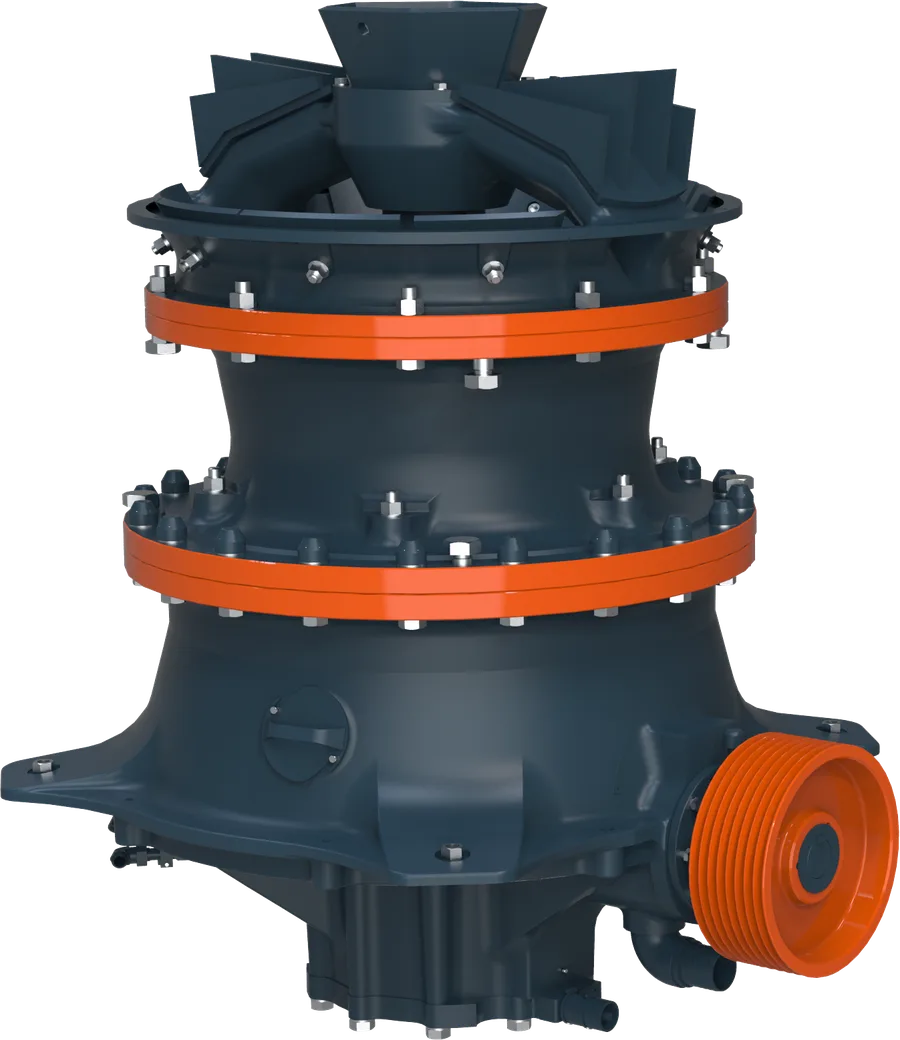
Secondary and tertiary cones decide product shape, recirculating load, and how often you fight the screen. NORDVIK offers three published cone families—PGP, PHP, and PCH/PCS—with overlapping capacities but different mechanical layouts and duty sweet spots. This guide helps purchasing and process engineers shortlist a series before they argue about a single model code.
Promotion and sales of NORDVIK™ crushers are handled by Luoyang Songju Industrial Equipment Co., Ltd.; NORDVIK is not a shipping brand. Quotes: sales@luoyangsongju.com.
Product pages (use these for tables): PGP, PHP, PCH/PCS.
Snapshot comparison (published framing)
| Series | Layout (as published) | Capacity | Feed (framing) | Power | Typical role |
|---|---|---|---|---|---|
| PGP | Single-cylinder hydraulic | 35–870 t/h | 46–442 mm | 75–400 kW | Secondary / tertiary; S cavities for coarser secondary feed |
| PHP | Multi-cylinder hydraulic | 45–790 t/h | up to 351 mm | 90–500 kW | High-capacity cones when cubical product and fast tramp release matter |
| PCH/PCS | Single-cylinder hydraulic | 77–2,100 t/h | 29–560 mm | 90–750 kW | Widest duty span in the cone family; plant standardization across stages |
All three families advertise automatic liner wear compensation to help hold CSS and product size as liners wear. That feature does not remove the need for correct cavity selection (EC / C / M / F / EF style chambers where offered).
Numbers above are series envelopes from live product SEO and page framing. Individual models sit inside those bands; always confirm capacity-at-CSS from the model table for your density.
PGP — single-cylinder workhorse for secondary and tertiary
PGP is positioned as a high-performance single-cylinder cone for secondary and tertiary crushing. Use it when you want a clear mapping from cavity to duty:
- S models — extra-coarse cavity for secondary duty, with feed openings up to the coarse end of the 46–442 mm framing (page FAQ notes S vs standard M/F cavities).
- Standard M / F cavities — tertiary and finer secondary reduction toward finished fractions.
- Power band 75–400 kW and 35–870 t/h cover many quarry secondaries and mineral tertiary stages without jumping to the largest PCH frames.
Buyer fit signals for PGP:
- You already know secondary vs tertiary CSS and want cavity letters (EC/C/M/F) to match feed.
- Plant tonnage sits comfortably inside mid-to-high hundreds t/h at design CSS, or you are sizing a known PGP frame (page FAQ cites PGP550 up to 870 t/h in coarse duty—treat as model-specific, not every PGP).
- You prefer single-cylinder setting and clearing logic familiar to many maintenance teams.
Liner options on PGP pages include Mn13Cr2 to Mn22Cr2 manganese grades by abrasiveness—specify ore type in the RFQ rather than guessing the hardest alloy by default.
PHP — multi-cylinder when shape and tramp release dominate
PHP is the multi-cylinder hydraulic cone in the NORDVIK lineup: 45–790 t/h, feed up to 351 mm, 90–500 kW. Multiple cylinders provide setting adjustment and iron release; published messaging emphasizes laminated crushing for a finer, more cubical product with fewer flaky particles—useful for aggregate specs that punish elongated stone.
Buyer fit signals for PHP:
- Product shape (cubicity) is a contractual KPI, not a soft preference.
- You want faster tramp release / precise setting control relative to spring or simpler single-cylinder habits (as described on the PHP page).
- Feed is within the PHP opening band and capacity target sits inside 45–790 t/h after screen recirculation is modeled.
PHP is not automatically “better” than PGP. Multi-cylinder machines shine when the flowsheet values shape and hydraulic clearing behavior; they still need correct CSS, choke feeding practice, and liner profile. Compare against PGP/PCH on your feed and product envelope—not on brochure adjectives alone.
PCH/PCS — widest single-cylinder span for plant standardization
PCH/PCS covers the widest published duty range in the cone family: 77–2,100 t/h, feed 29–560 mm, power 90–750 kW, still in a single-cylinder hydraulic layout. That span matters when a mine or large quarry wants one mechanical family across coarse secondary and fine tertiary, with cavities from EC down to EF on listed models.
Buyer fit signals for PCH/PCS:
- Design t/h or feed opening sits above comfortable PGP/PHP mid-frames, or you need headroom toward the high end of the cone envelope.
- You want one series language for spare parts training across several stages.
- CSS must stay stable across long campaigns—specify automatic liner wear compensation and a liner stock plan together.
Some models may be omitted from public tables (“contact for complete range” on-page). For RFQ, list required t/h at CSS and feed top size; do not assume every intermediate frame is stocked identically.
How to choose: a practical sequence
- Fix the stage — secondary after jaw/gyratory, or tertiary/quaternary after secondary cone.
- Fix product — target CSS or P80, and whether cubicity is measured.
- Fix feed to the cone — max mm and expected grading after the previous stage (not ROM size).
- Estimate circulating load — screen aperture and closed-side circuit will move “nameplate” t/h.
- Shortlist series:
- Mid secondary / tertiary, single-cylinder familiarity → PGP
- Shape-critical aggregate, multi-cylinder preference → PHP
- Wide tonnage / large feed / one-family standardization → PCH/PCS
- Pick cavity + alloy — EC→EF style as offered; Mn grade from abrasiveness.
- Require wear compensation language in the PO if CSS drift has hurt you before.
Common specification mistakes
- Sizing on motor kW only — two cones with similar kW can differ sharply at the same CSS.
- Ignoring recirculating load — open-circuit brochure t/h overstates closed-circuit plant output.
- Wrong cavity for feed — forcing coarse feed into a fine chamber causes bridging, low utilization, or liner damage patterns.
- No liner plan — cones without stocked mantles/concaves become availability problems; use crusher spare parts early.
- Mixing series logic in one RFQ — ask for a recommended series first, then model; comparing every SKU at once slows technical clarification.
RFQ template for cone selection
Subject: Cone crusher series RFQ — PGP / PHP / PCH-PCS — [project]

- Stage: secondary / tertiary / other:
- Feed to cone: max mm, grading, moisture, abrasiveness:
- Target product: CSS or size band / cubicity requirement:
- Design t/h at cone (include estimated recirculating load):
- Upstream primary type (jaw / gyratory / other):
- Preferred series if any (PGP / PHP / PCH-PCS) or open:
- Power system limits (kV / kW):
- Automatic liner wear compensation required? (yes/no)
- Liner alloy preference or ore wear class:
- Quantity of machines / future expansion:
- Ship-to / timeline:
Email sales@luoyangsongju.com. Songju Equipment will map duty to PGP, PHP, or PCH/PCS using published openings and capacity bands—without inventing certifications or case-study tonnages.
Call to action
Ready to shortlist a cone series? Send the template to sales@luoyangsongju.com, or open PGP, PHP, and PCH/PCS model tables side by side.