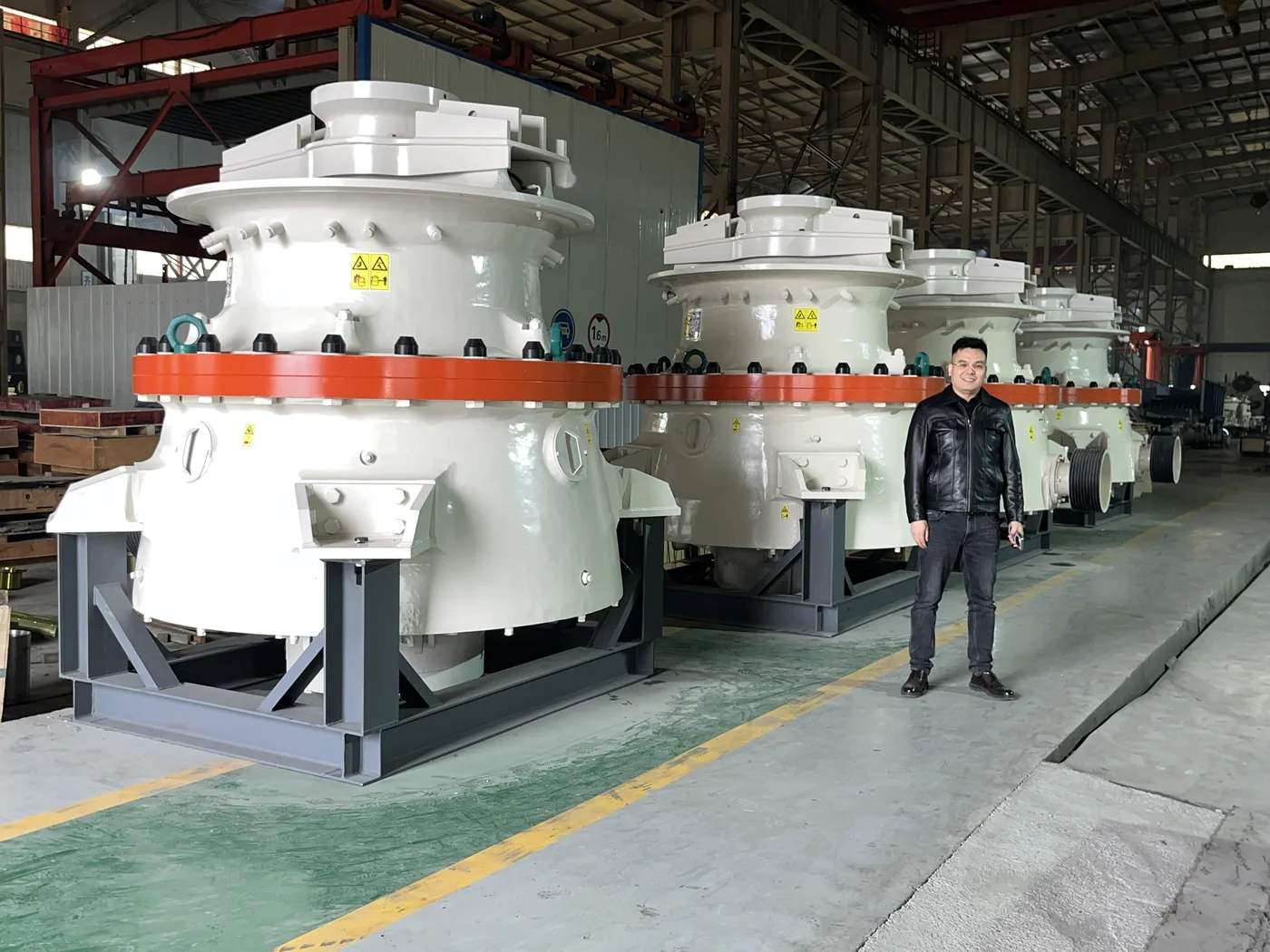
Two crushers, one control room
In August 2026 two tertiary MAQ-GP550 cone crushers entered commissioning at an iron-ore plant in Venezuela, one on the PTLB I line and one on PTLB II. Each machine sits in the fine-crushing stage. It takes pre-crushed ore and holds a closed-side setting so the rest of the circuit sees a stable product. Luoyang Songju Industrial Equipment supplied the NORDVIK crushers with their hydraulic stations and the control cabinets that, in the factory arrangement, stand beside those stations.
The plant already runs from a central control room. To keep the new crushers on the same desks as the rest of the line, the site team moved the electronics out of each hydraulic-station cabinet and into a cabinet about 100 metres away, in the electrical room. The original cabinet stayed beside the station as a junction box. Operators could start and stop the crushers from the plant DCS and from the crusher's own HMI. On PTLB II the upper frame was turned 90 degrees so the feed hopper met the belt feeder, and one hydraulic hose was lengthened where the station sat a little farther from the crusher than the general arrangement had assumed.
Empty-load runs were completed, and the mechanics behaved. Two faults then occupied the rest of commissioning. They look unrelated from the walkway: a closed-side setting the screen would not report honestly, and a cone that would not stay where the hydraulics had put it.
A CSS reading the lead test would not confirm
The displacement sensor on a MAQ-GP550 reports main-shaft position. From that position the control system calculates the closed-side setting, the CSS. From the first days of commissioning the reading was unstable. The signal between sensor and HMI dropped out, returned, and dropped out again. When it was on the screen, a lead-slug check of the real gap disagreed with the display by 8 to 10 millimetres. A setpoint entered as a working CSS drifted on its own. The HMI stayed powered, but the crew stopped using it for setting and checked the gap by hand.
That pattern is often laid at the sensor. Here the sensor reported exactly what the cable brought to it.
Interference on a 100-metre run
The hydraulic-station cabinet is built to sit at the station, with short runs to the displacement sensor and the other local instruments. Once its electronics had been moved about 100 metres into the control room, those signals travelled the long way, on cable pulled and terminated during the rewiring. The run picked up interference, and the position reading became unreliable.
Replacing that long run with shielded cable cleared the interference. The displacement signal settled, and the closed-side setting on the screen could be used again.
Shielded cable is the right repair once the cabinet has already moved. When the customer tells NORDVIK before the contract that the hydraulic-station cabinet will sit in a remote control room, we design a network control cabinet — an Ethernet version — so distance is no longer a limit. The analogue instruments stay beside the machine. What crosses the plant is a network link, agreed on the drawing while the layout is still paper.
A cone that sank with the pressure
The second fault showed up as a cone that settled. The adjustment circuit could not hold the hydraulic pressure that keeps the main shaft at the selected height. The cone dropped on its own, including while the crusher was stopped, and the setting could not be established. Empty-load testing was stopped because the closed-side setting was out of control. The pressure was leaving through the relief valve.
Iron filings in the relief valve
This is the relief valve, also called the safety valve or dump valve. It protects the crusher in an overload. At a set pressure it opens, lets the shaft down and releases an uncrushable piece. When that piece has passed, the valve reseats and the crusher climbs back to its working pressure.
Inside the valve we found iron filings. The particles held it off its seat, so the adjustment circuit could not build pressure and could not keep it. Cleaning the valve restored the seat. Pressure came back, and the cone stayed at the position the operator had selected.
Filings of that size stay invisible on a pressure gauge. They travel in from a cut hose, an opened fitting, or a line left unflushed after fabrication. On a relief valve they are enough for the whole adjustment circuit to lose its pressure.
What to settle before the next project
Both faults were closed on site. The next project goes more smoothly when the control-room distance, and any hose work the site will do, are on the table before the machines ship.
- If the control room will be remote from the hydraulic station, say so before the contract. NORDVIK will supply a network control cabinet: sensor cables stay short, and the long link is Ethernet.
- Treat the relief valve as a part for which cleanliness is critical. Flush the adjustment circuit and inspect the valve before the first pressure test, especially after hoses have been opened or extended on site.
- Put the original cabinet's cable route on the design review. A junction box and 100 metres of ordinary multicore change the circuit that left the factory.
- Agree in advance how the crusher HMI and the plant DCS share start, stop and interlocks, so calibration uses a screen the operators still trust.
If you are placing MAQ-GP550 cone crushers in an operating plant — iron ore or any other hard feed — and the control room sits away from the hydraulic station, write to NORDVIK while the layout is still a drawing. Luoyang Songju Industrial Equipment will match the cabinet to the real cable route and stay with the circuit through commissioning. Send the flowsheet and the distance between the station and the control room, and we will start from there.